The framework
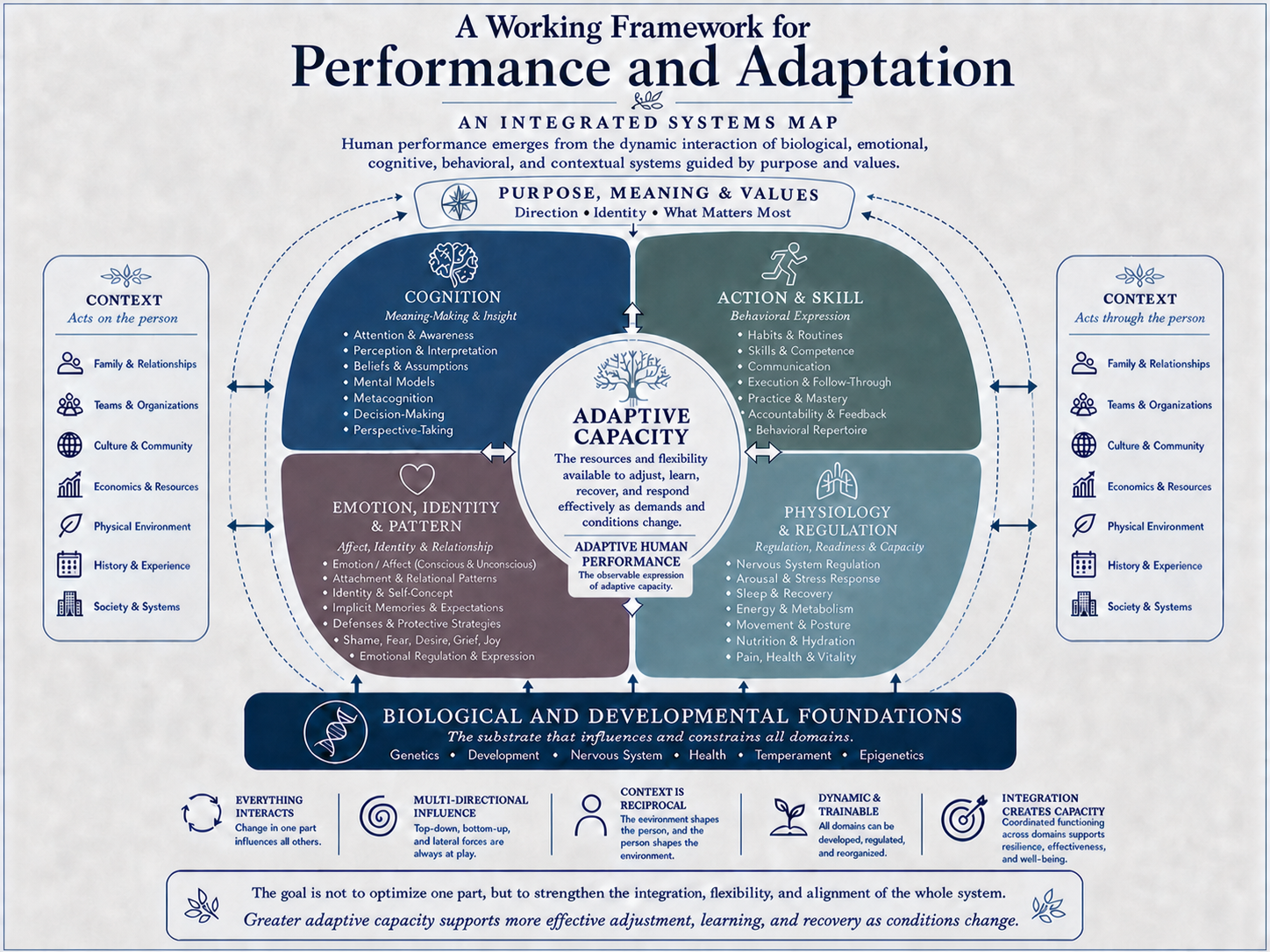
An integrated framework for performance and adaptation.
The framework considers performance in context. It examines how cognition, action, emotion, identity, physiology, development, relationships, and environment interact to shape how a person functions when it matters.
How to read the framework
This framework treats performance as an expression of interacting influences.
Begin at the top. Purpose, meaning, and values give the system direction: who the person is trying to be, what matters, and why the work is worth doing.
The four central domains are cognition, action and skill, physiology and regulation, and emotion, identity and pattern. They are not separate compartments. They continually shape one another. A change in sleep may alter attention; a relational pattern may constrain action; a belief may intensify physiology; repeated practice may change confidence and identity.
Biological and developmental foundations influence the entire system, while relationships, organizations, culture, resources, and historical and systemic conditions act on the person and are also shaped through the person. At the center is adaptive capacity. Here, adaptive capacity refers to the resources and flexibility available to adjust and learn as demands and conditions change.
Psychological flexibility, a central construct in Acceptance and Commitment Therapy, is one part of adaptive capacity, not another name for the whole construct. It involves staying in contact with present experience, adjusting behavior when needed, and acting in ways aligned with values rather than being governed entirely by avoidance or habit.
Past experience also shapes what the system expects to be safe, threatening, or possible. Under pressure, those expectations can become rigid and outweigh new information. Change involves conditions in which a person can notice, test, and revise them while developing the skills and support needed for a different response.
Cognition
Not only what someone thinks, but what organizes the thinking.
Attention, perception, beliefs, learned expectations, mental models, metacognition, decision-making, and perspective-taking shape how experience is interpreted. A person can understand exactly what to do and still lose access when attention narrows, threat changes meaning, or the gap between knowing and doing opens under pressure.
Action & skill
Behavioral expression.
Habits, communication, execution, practice, feedback, and behavioral repertoire translate capacity into effective action. The practical question is not whether the skill exists in practice, but whether it remains available when fatigue, uncertainty, evaluation, and consequence enter the moment.
Physiology & regulation
The system in motion.
Arousal, sleep, recovery, energy, movement, nutrition, pain, and the nervous system’s current capacity shape what is available in the moment. A problem that presents as anxiety or inconsistency may begin with recovery, stress load, pain, energy availability, or a body operating beyond its current capacity.
Emotion, identity & pattern
Affect, attachment, identity, and relationship.
Affect and motivation help organize learning and action from the bottom up. Emotion, attachment, self-concept, implicit memory, defenses, relational patterns, and regulation influence what is protected, repeated, or avoided. Perfectionism, over-preparation, conflict avoidance, or self-sabotage may reflect adaptations that were once protective but now organize the moment before conscious choice.
Evidence and limits
A working formulation framework, not a diagnostic instrument.
The framework considers both performance and psychological well-being. Adaptation may involve adjustment, recovery, learning, or growth, but adversity does not inherently produce improvement. It is a formulation framework, not a diagnostic model.
The framework draws on established work across performance psychology, affective neuroscience, psychotherapy, and systems thinking. It is my working synthesis of established domains of human functioning. It has not been independently validated and should not be understood as a diagnostic instrument, treatment protocol, or outcome model.
Adaptive capacity is used here as an evidence-informed organizing concept. It is not presented as one standardized psychological construct with a single accepted measure.
It is informed by biopsychosocial and ecological approaches to human functioning, research on adaptation under sustained demand, and the psychological flexibility model developed within Acceptance and Commitment Therapy. My peer-reviewed work on antifragility also informs how the framework considers adaptation under adversity.
These traditions inform the synthesis. They do not validate the framework as a whole or establish every relationship proposed within it.
Predictive processing remains a developing explanatory lens for how prior experience may shape perception, expectation, and learning. Neuropsychoanalysis is used as an interdisciplinary lens for thinking about affect, embodiment, and processes outside awareness. Neither is presented as a settled unified theory of psychotherapy.